Air freight is the transportation of goods by aircraft. It is commonly used when businesses need to move cargo internationally and delivery time is an important consideration.
The process is not limited to the flight itself. It includes booking, cargo preparation, documentation, customs procedures, airline handling and final delivery.
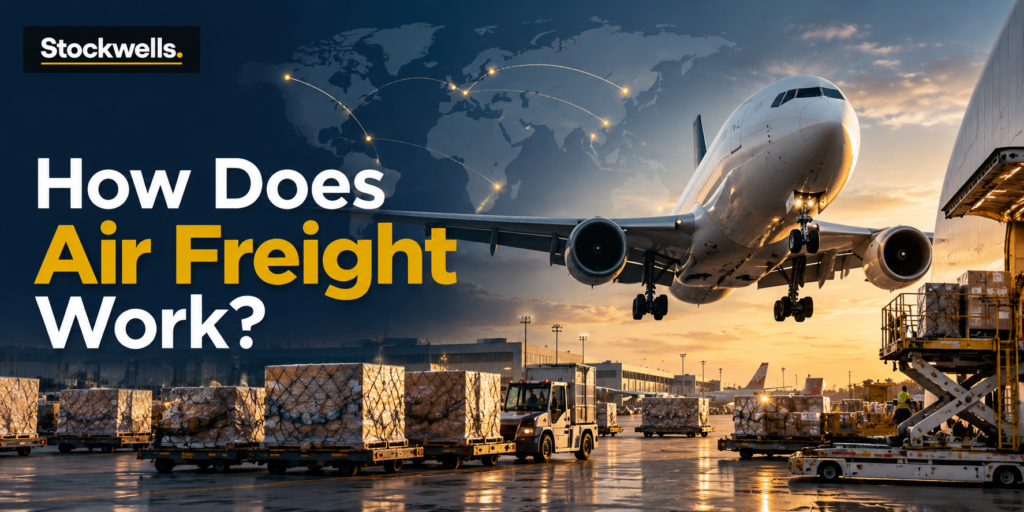
How Does Air Freight Work?
The air freight process generally follows these steps:
1. Shipment Details Are Confirmed
The shipper provides the cargo description, quantity, weight, dimensions, origin and destination. These details help determine the appropriate shipping arrangement.
2. Air Freight Is Booked
A freight forwarder arranges the shipment with an airline based on the cargo requirements, destination and available routing.
3. Cargo Is Prepared
The goods are packed, labelled and prepared for transportation. Special requirements may apply depending on the type of cargo.
4. Documents Are Prepared
Common documents may include a commercial invoice, packing list and Air Waybill. Additional documents can be required depending on the goods and countries involved.
5. Export Procedures Are Completed
The shipment may need to pass through export customs procedures before it can leave the origin country.
6. Cargo Is Transported by Air
After airline handling and required security checks, the cargo is loaded and transported to the destination airport.
7. Import Clearance Takes Place
At the destination, the shipment may need to complete customs and other import requirements before release.
8. Final Delivery
Once the cargo is released, it can be transported from the airport to the agreed final destination.
Air Freight Process at a Glance
| Stage | What Happens |
|---|---|
| Shipment Planning | Cargo and shipping requirements are reviewed |
| Booking | Air transportation is arranged |
| Cargo Preparation | Goods are packed and prepared |
| Documentation | Required shipping documents are completed |
| Export Clearance | Applicable export procedures are completed |
| Air Transport | Cargo travels to the destination airport |
| Import Clearance | Destination requirements are completed |
| Delivery | Cargo moves to its final destination |
What Information Is Needed for Air Freight?
Before requesting an air freight arrangement, it helps to have basic shipment information ready.
| Information | Why It Matters |
|---|---|
| Cargo description | Identifies what is being shipped |
| Weight | Used for freight calculation |
| Dimensions | Helps determine chargeable weight |
| Number of packages | Defines shipment quantity |
| Origin | Determines pickup and export requirements |
| Destination | Determines routing and import requirements |
| Required timeframe | Helps assess the suitable transport option |
Accurate information is important because freight charges and handling requirements can depend on the shipment details.
Air Freight vs Sea Freight
Air freight is generally selected when speed is more important, while sea freight is commonly considered for larger shipments where transportation time is less critical.
| Air Freight | Sea Freight |
|---|---|
| Generally faster | Generally slower |
| Usually higher cost | Often more economical for larger volumes |
| Suitable for time-sensitive cargo | Suitable for less time-sensitive cargo |
| Airport-based transportation | Port-based transportation |
What Can Affect Air Freight Transit Time?
The flight itself is only one part of the overall process. Total shipment time can also be affected by cargo preparation, documentation, customs clearance, flight routing, handling and final delivery.
For this reason, an airline transit time should not automatically be treated as the complete door-to-door delivery time.
Frequently Asked Questions (FAQS)
01 Is air freight faster than sea freight?
Generally, yes. Air freight is normally chosen when faster transportation is required.
02 Is air freight more expensive?
Air freight generally costs more than sea freight, although the actual cost depends on the shipment, route, weight and other requirements.
03 What documents are required?
Common documents include a commercial invoice, packing list and Air Waybill. Exact requirements depend on the shipment.
04 How is air freight charged?
Charges can depend on actual weight or volumetric weight, along with the route, cargo and applicable handling requirements.
05 When should I choose air freight?
Air freight can be considered when shipment speed is important or when waiting for sea freight may not suit the business requirement.
Final Takeaway
Air freight follows a clear process: plan the shipment, book the cargo, prepare the documents, complete customs procedures, transport the goods by air and arrange final delivery.
Having accurate cargo details and documents ready from the beginning can make the process easier to understand and manage.